
Dongguan Shenhua Mechanical And Electrical Equipment Co., LTD
Dongguan Shenhua Mechanical And Electrical Equipment Co., LTD

Q1: 【PCBA Aqueous Cleaning vs Solvent Cleaning】Against the backdrop of tightening environmental‑protection regulations, what core advantages do PCBA aqueous cleaning machines have over traditional solvent cleaning?
A: Shenhua Electromechanical inline PCBA aqueous cleaning machine adopts a closed‑loop aqueous cleaning system combined with multi‑stage filtration and counter‑current rinsing technologies to deliver the following performances:
Environmental Compliance: Meets China’s Limits of Volatile Organic Compound Content for Cleaning Agents as well as EU RoHS/REACH requirements. Wastewater discharge is 30% lower than the industry standard.
Cleaning Performance: Effectively removes flux residues, solder balls and organic contaminants. The post‑cleaning ionic contamination complies with MIL‑STD‑2000A (≤1.56 μg NaCl eq/in²).
Cost Optimization: The aqueous cleaning solution can be recycled. Combined with wastewater treatment equipment, long‑term operating costs are reduced by approximately 20%‑30% compared with solvent cleaning.
Q2: 【Stencil Cleaning and SMT Yield】What impacts does incomplete stencil cleaning exert on SMT placement yield? How does the SME‑series electric stencil cleaning machine address this pain point?
A: Industry surveys indicate that 78% of SMT manufacturers suffer higher placement defect rates caused by insufficient stencil cleaning. Residual solder paste and flux will lead to:
Aperture clogging resulting in insufficient solder paste printing volume
Changed surface tension of stencils, triggering solder paste slumping / bridging
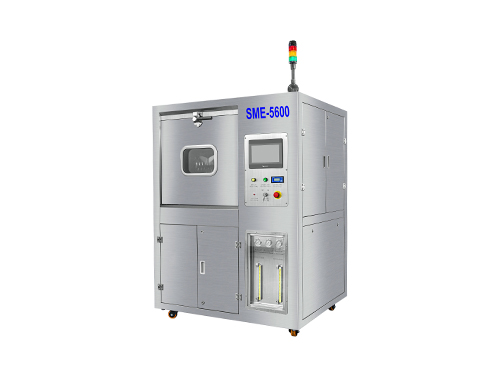
Shenhua Electromechanical SME‑series electric stencil cleaning machine applies combined spray‑ultrasonic cleaning technology and supports simultaneous cleaning of two stencils. Used with dedicated aqueous cleaning fluid CTS‑10, it achieves:
Removal rate of residues inside stencil apertures ≥99.5%
Pre‑set PLC programs compatible with various stencil specifications, cutting change‑over time by 40%.
Q3: 【Reflow Condenser Maintenance】What role does the SM‑series reflow condenser cleaning machine play in production‑line maintenance? What hidden costs will arise without regular cleaning?
A: After long‑term operation, solder dross residues gradually clog the condenser pipelines of reflow ovens, which will cause:
Degraded heat dissipation and shifted reflow temperature profile
Approximately 15%‑20% higher energy consumption
Unscheduled manual cleaning shutdowns in severe cases, hurting production capacity
Shenhua Electromechanical SM‑series reflow condenser cleaning machine adopts high‑pressure directional spray plus hot‑air drying process to complete internal cleaning without condenser disassembly. A 2025 case shows that after a large South China automotive electronics manufacturer deployed this unit, condenser operational stability rose by around 30%, and annual maintenance downtime decreased by 25%.
Q4: 【Fixture Service‑life Management】How do fixture cleaning machines help EMS factories extend fixture service life and lower rework rates?
A: After repeated thermal cycling, soldering fixtures (e.g. wave‑solder carriers, reflow trays) accumulate flux residues and solder beads on surfaces, resulting in:
Fixture deformation and broken latches
Deteriorated PCB positioning accuracy
Premature fixture scrapping
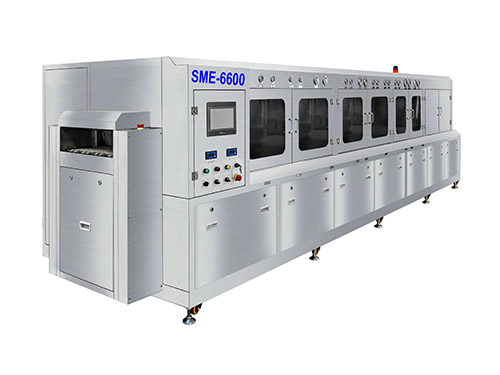
Shenhua Electromechanical fixture cleaning machine uses multi‑station rotating spray technology to reach blind holes and narrow gaps of fixtures. After deployment by a global leading automotive electronics manufacturer (Dongguan plant), fixture service life was extended by 30 % and rework rate dropped by 25 %. The equipment supports memory for fixture specifications and accommodates carriers of different dimensions.
Q5: 【Semiconductor Packaging Cleanliness】How does the SC‑series SEMI packaging cleaning machine satisfy high‑cleanliness requirements in semiconductor packaging processes?
A: Semiconductor packaging components (e.g. lead frames, substrates) impose stringent cleanliness requirements:
Clean‑room class: Class 100 or higher
Particle residue: ≤10 particles/cm² for particles ≤0.5 μm (GB/T 34510‑2017)
Ionic contamination: ≤1.56 μg NaCl/cm²
Shenhua Electromechanical SC‑series SEMI packaging cleaning machine features fully‑enclosed chamber design and HEPA filtration system. Its cleaning accuracy reaches ±0.3 μm with stability deviation kept within 0.8 %. When paired with DI‑250 / DI‑100 industrial deionized‑water generators, the resistivity of cleaning water can be guaranteed at ≥18 MΩ·cm.


Sweep the official account of WeChat
Scan personal wechat
About Shenhua
Company introduction Company history Company culture Company patents Company patents Corporate imageProducts center
Semicon packaging machines PCBA cleaning machine Stencil cleaning machine Pallet cleaning machine Screen cleaning machineApplication
Semicon packaging Car electronics Military, Medical New energy Digital MetersNews
Company news Industrial news